 Manticore Press
Vladimir V. Wiedemann
In the Oxford Museum of the History of Science there are preserved two relics of peculiar eloquence: upon a white tablet, the Enochian alphabet of John Dee, written in black; upon a black tablet, the formula of Albert Einstein’s theory of relativity, written in white. With the first, British science may be said to have begun; with the second, scholarship reached its zenith. Between them lies a journey of three hundred years—from magical metaphysics to nuclear physics.
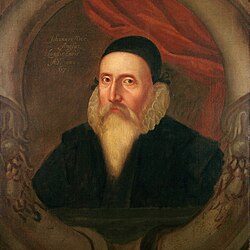
Does this mean that the name of Dr Dee survives only in the footnotes of history, and that his discoveries and ideas have lost all living power? Surely not. Dee’s intuition grows more pertinent with every passing year, and most of all in a world riven by social, political, cultural and religious difference.
Dee sought “universal knowledge”, or Gnosis: the possession of which, he believed, would permit humanity to attain harmony and happiness. Yet Dee was no mere dreamer. As one of the leading intellects of his age—keeper of the largest library in Britain, a man who moved amongst the most exclusive cultural, scientific and political elites of Europe—he weighed every road to social progress and every means of reaching it. He knew full well that global ends require a power of planetary reach: a structure granting access to scientific, technical and, not least, human advance. In this, Dee stands in the best tradition of the European Renaissance and of humanist thought, and he was a pioneer of that universal movement in England.
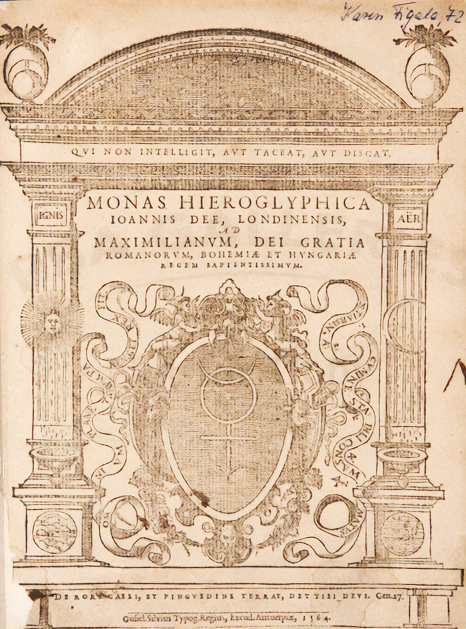
Dee’s “Universal Theory of All” is set forth in his Hieroglyphic Monad: a figure binding together the seed-principles of geometry, alchemy and myth, each traced in the spirit of Neo-Platonic syncretism, yet raised to the highest pitch of contemporary thought. Using the Monad as an intellectual key, Dee unfolded his political metaphysics, whose aim was a worldwide union of peoples and cultures beneath the wing of the British Crown. For him, it was an instrument for influencing sublunar humanity.
From Dee’s seed, Hegel would later draw his own philosophical and political doctrine of Absolute Spirit as the metaphysical subject of the Prussian monarchy. Hegel believed that Germany had taken from Britain the mantle of global leadership. Hence arose German messianism, which in two centuries would carry the country to the Third Reich.
History has known other ideologies of dominion, and not only in Europe; but the most enduring of them was cast in Dee’s British mould—the paradigm we may call Anglo-Saxonium.
The Geopolitics of the North
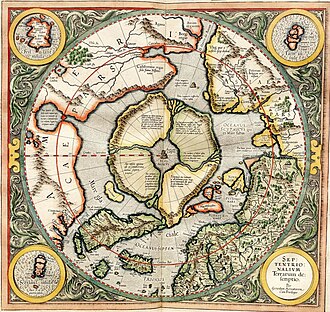
John Dee drew the first foundational sketch of global British geopolitics—a design he sought to realise under Queen Elizabeth I. His aim was to unite beneath the authority of the British Crown all the northern lands of the planet, or at least those as far as the fiftieth meridian, with the North Pole as the planetary epicentre of magical influence. Who holds the Pole holds the world—metaphysically speaking, at least.
Here one may recall the legends of mystical Mount Meru as the axis of the Earth and of celestial time; the centre of Kalachakra, the wheel of time; the mythical Arctogais, the northern land; or the mysterious Ultima Thule, the ultimate island, which only the wise may find by the alchemical compass.
Drawing upon medieval legend, Dee sought to justify the power of the British Crown over northern territories such as Scandinavia, Greenland and Canada. He found other lands—Northern Eurasia above all—more difficult, held as they were by the Russian Crown. Thereupon Dee proposed a stroke of genius: the marriage of Elizabeth I to Ivan the Terrible, to seal a dynastic union and beget a legitimate line. Any child of that union would inherit a future Eurasian-American empire, which Dee called “Greenland”—not to be confused with the Danish island of Greenland.
But the dynastic marriage was only the beginning. The great Welshman next proposed to open the subarctic lands of North America and Eurasia, and to discover a Northern Sea Route from Europe to China and India. The enterprise was to be carried out by free citizens—that is, by private trading companies. To this end, Dee’s agents in Russia, his own son among them, founded the Muscovy Company.
The Geopolitics of the South
These plans were not destined to be realised. Strangely, it was not the Muscovites who thwarted them, but English pirates—or, more precisely, one of the most celebrated privateers in history: Sir Francis Drake. He won the Queen’s trust and offered her, in place of a geopolitics of the Northern seas, a geopolitics of the Southern seas: a road to the East by way of the south. The engine of this new policy was to be the East India Company, which contributed to the colonisation of southern lands such as Africa, India and Australia. America, by contrast, was worked through the West India Company. Thus Britain turned away from Northern Eurasia, leaving Moscow free to colonise vast tracts of it as far as Alaska and, in part, California.
There followed, inevitably, upheavals: the Anglo-Russian Great Game for mastery of those southern regions of Eurasia that lay adjacent to Britain’s southern seas. The Game continues even now, in the endless geopolitical confrontation between the Anglo-Saxon and Russian spheres of influence; and military and political leadership within the Anglo-Saxon world passed, after the Second World War, to the United States.
Yet Britain’s role in the world—whatever partisan analysts may say—remains formidable: chiefly because of the singular role of English common law in the lands once swayed by London, the United States included. It is, more precisely, the continuing influence of a British cultural tradition that must be named. For civilised humanity, the rule of law is a greater power than the sword. As the Romans observed, the Emperor’s power differs from that of barbarian kings: the one rests upon the solidarity of free citizens, the other upon brute coercion.
New Challenges
The world’s geopolitical order is changing before our eyes. New actors have entered the political stage—actors who, half a century ago, carried almost no weight in international affairs. So too have the technologies of influence and control, of production and logistics, of education and cultural formation, been transformed. All this compels decision-makers to revise their strategies and the rules of global activity, including financial, political and military-strategic objectives. The coming struggle for a New World Order will turn, in all likelihood, upon the United States and China. Every other great player—Russia included, and a still-united Europe—is left to watch the current and to avoid unilateral decisions.
Yet it cannot be said with certainty that China will step forth as America’s open geopolitical opponent. It is equally possible, in theory, that China will oppose any new Eurasian alliance between Russia and continental Europe, or between Russia and India, while the United States turns to consolidating the Western Hemisphere around itself. Many configurations are possible, and few would dare to prophesy the next decade, let alone the longer prospect. Nevertheless, the dynamics of development in different countries and territories, the arrangement of resource fields and transport corridors, and ecological and demographic factors will help to identify the critical scenarios, whose probability is high.
Whichever scenario is realised, a systematic approach to global problems allows us to optimise the instruments of influence upon global processes in the interests of individual members in any new phase of the Great Game—albeit in a geopolitical sense that is wholly new and not wholly transparent. In our judgement, however, the most unpredictable player in the first league is, strangely, Russia. Russia is a wild card: her supposedly “anti-Western” posture arises not from geopolitical position or national culture, but from circumstance. In that case, Russian “rivalry” might be transformed into reliable partnership with the Western countries, once a coherent approach is adopted. Plainly, the reactivation of the intellectual—and perhaps magical—legacy of that great Welshman, the first Agent 007 in Her Majesty’s service, as he signed his reports at Court, may hasten these developments.
First, the value of trade and communication in the Southern seas is being systematically reduced—at least initially—for two reasons:
- Technological development, which makes possible the effective laying of land routes between Western Europe and East Asia—a New Silk Road—and confers great geo-strategic advantage upon China;
- Global warming, which melts the northern ice and turns the Northern Sea Route into a new, effective and safe trade route.
These two divergent tendencies prepare a highly probable future, together with a direct confrontation between Moscow and Beijing in the contest for new trade routes: one continental, from London to Singapore; the other maritime, from London to Alaska. Every calculation suggests that the Northern Sea Route will prove more effective and safer than the southern passage. It is no surprise, therefore, that China has advanced the concept of a “Greater Arctic” and claimed a participatory right in the infrastructural development of the Northern Sea Route. Yet the fact remains that Russia would not be content with such a partner, for all Beijing’s offers of investment.
The principal reason for Russia’s unease is not economic but demographic: a factor that could permit Russian Siberia to be transformed after the manner of Chinese Tibet. That prospect is still distant, to be sure; but long-term strategic partners in such a global project must be chosen soon, if not at once. Here the West—and above all the Anglo-Saxon world, the vanguard of the West—holds a trump card. The reader of this manifesto may already guess that it entails the resurrection of John Dee’s geopolitical project, which we may call “Greenland-2”. Let us turn to details.
The project is practical. Direct access to the Arctic Ocean, the principal arena of the Northern Sea Route, is held by five Nordic powers: Russia, Canada, the United States, Norway and Denmark through Greenland. Of these, only Russia stands outside the Western military and political system; yet, by culture and history, there are a number of favourable legal precedents whose existence may incline this giant Eurasian partner towards the West in any long-term and mutually beneficial arrangement.
The Nordic Inheritance
Let us begin with a brief excursion into the history of the Russian state and its relations with the other political formations of northern Europe, Britain among them. The traditional Russian aristocracy, rooted in the Northern House of Rurik—descendants of the legendary Varangian prince—took possession of Gardariki, the north-western lands of modern Russia, in the ninth century. Moreover, the Vikings—close kin to the Scandinavian peoples—brought to Gardariki not only the traditional political structures of the northern kings but also the rudiments of Scandinavian law as codified by Prince Yaroslav the Wise in his Russkaya Pravda, the founding document of ancient Russian law. Nor did these Scandinavian roots lie behind the Russian legal tradition alone; they stood equally behind the English. The same Vikings established the Danelaw in the British lands in the ninth century.
Even before the Varangians and the Vikings, in the seventh century, the legendary King Ivar Vidfanne, a Scylding, united under his rule almost the whole of northern Europe—from Britain to Gardariki, including Scandinavia, Denmark, the Netherlands, northern Germany, southern Finland and the Baltic lands. Ivar’s warriors spoke East Scandinavian dialects, which they carried to East Anglia and to eastern Gardariki as far as Belo-Ozero, some five hundred kilometres east of the Gulf of Finland. Ivar Vidfanne’s empire was the most powerful political entity of early medieval northern Europe, with the North Sea and the Baltic forming its inland waters. The Scyldings themselves—to whom Rurik also belonged—were held to be direct descendants of Odin, a lineage that legitimised their claim to supremacy among the Vikings and the other ancient Germanic peoples.
From the seventh century onward, the Varangian Vikings and the Normans—the “northern people”—began to seize control of the sea and river trade routes of northern Europe, and thence of the southern arena as far as North Africa and the Black Sea. The river road from Gardariki to Constantinople, traditionally called the route from the Varangians to the Greeks, with Scandinavian trading posts along its whole length, was the central axis of the consolidation of the Old Russian state. In the east, Varangian ships—drakkars—reached the borders of the Khazar Khaganate and Khorezm; in the west, they reached Iceland, Greenland and the north-east coast of Canada, known as Vinland.
Thus the Norman expansion proceeded in two opposite directions, east and west; and these two movements laid the foundations of the Anglo-Saxon world of the North Atlantic and of the Russian world of northern Eurasia. In time, the descendants of those ancient pioneers, each following their own course, met upon the border between Asia and America, where the Russian-American frontier runs today. That meeting, two hundred years ago, completed the European colonisation of North America and northern Eurasia—the Great Greenland of John Dee’s imagination.
The Question of Law
Returning to the present, we note another common inheritance: the Norman heritage of Russians and Anglo-Saxons. Modern Russian law and the law of the Anglo-Saxon countries are, of course, quite distinct. In Russia and her former colonies, as in all the countries of continental Europe, there prevails the Romano-Germanic system of written law, in contrast to the case-law system of English common law, the type that obtained across the former colonies of Great Britain. At the same time, Russian law—until the overthrow of the monarchy in 1917—contained elements of common law, reaching back to the legal heritage of the Russkaya Pravda.
After the Russian Revolution, the whole system of traditional law, written and case alike, was abolished in favour of new forms of case law: the so-called Revolutionary Law of the Soviets. Each Soviet, as a political cell of Soviet power, was said to possess full sovereignty. That system did not endure; soon legal regulators reappeared, grounded in the Romano-Germanic model. In this, the case law of the Soviet authorities continues to operate de facto, though it has been transformed into the “law” of Bolshevik tyranny. What matters greatly is that the Russian legal mentality still admits common law and its logic, following the historical norms of customary law with far greater readiness than the written rules of “Romano-Germanic” bureaucracy.
Seen in an international context, the situation reveals a global confrontation between two systems of law: common and precedent, English and Romano-Germanic. By established practice, international trade law follows the Anglo-Saxon tradition, while criminal law follows the Romano-Germanic. Hence the primacy of the Commercial Court in London in matters commercial, and of the courts at The Hague in matters criminal. In business, common-law countries practise a more liberal approach to commercial and financial transactions—an approach not merely unwelcome in continental Europe but, in some jurisdictions, prohibited by law, as in Germany, for being too risky. This was one reason, among others, for Brexit: the European Union has too much red tape, which actively impedes free enterprise. Moreover, Russia’s transition to common law—binding her to the new coalition of India, a common-law country—would draw in that key partner of the Free World in South Asia.
Here we come to the central question of our project: Russia’s integration into the structures not merely of the West, but of the Free World. It is enough to imagine the Russian world returning to its natural legal roots through a gradual transition to Anglo-Saxon common law. This would at once permit the country to integrate effectively into the global processes of the new political and economic realities that began to assert themselves with force after Brexit. In theory the same would be advisable for continental Europe; but the institutional tradition of bureaucracy—the so-called “state of law”—is far stronger there than in modern Russia. To evolve it in the near future seems impossible. What is more, once Russia takes account of the real mentality of her elites, such a transition is easy. Indeed, all that is significant in the country’s economic and financial litigation would take place in the Commercial Court in London.
A serious change in Russian legal principles will, of course, require time; yet if one recalls the example of Gorbachev’s perestroika, when the whole institutional system of a giant empire—its basic ideological concepts included—was suddenly set in motion, the case is far from hopeless. What is required is a clear understanding of the technical problems and the consistent implementation of a solution on all fronts.
The New Development
A great international project, “Greenland-2”, engaging the United States, Britain and Russia, could become the basis for a new area of global prosperity and security in the northern part of our planet. The building of infrastructures, the unification of the Northern Sea Route in Russia, the Northwest Passage between Canada and the United States, and an Arctic Bridge between Greenland and Canada, would create a durable mechanism for the sustainable development of new and promising lands. It would open the way to productive investment in keeping with the coming changes in the natural and political climate of the planet. The Greater Arctic lies far from the hot spots of international conflict and is all but inaccessible to the destructive elements of the “problematic” South.
The project is still at an early stage; it could therefore be advanced swiftly with the participation of experts from all interested countries, Britain among them as a key institutional partner of the United States and Canada. We therefore propose to begin through a series of specialised conferences, at which professional reports may be heard upon the subjects here discussed, together with the views of relevant experts.
The Conferences
John Dee and His Heritage
- The history of Western science;
- British geopolitics from Dee to Mackinder;
- The Great Game for Eurasia: British and Russian contradictions;
- American and Soviet opposition from the Second World War to the present;
- New challenges: between Atlanticism and Eurasianism.
The New Development
- The history of glorious ancestors: Vikings, Varangians and Normans;
- The question of law: common and continental systems;
- The Anglo-Saxon world, the European Union and the post-Soviet countries;
- The Chinese factor;
- A New Deal: international joint venture around the Arctic Ocean.


