 Manticore Press
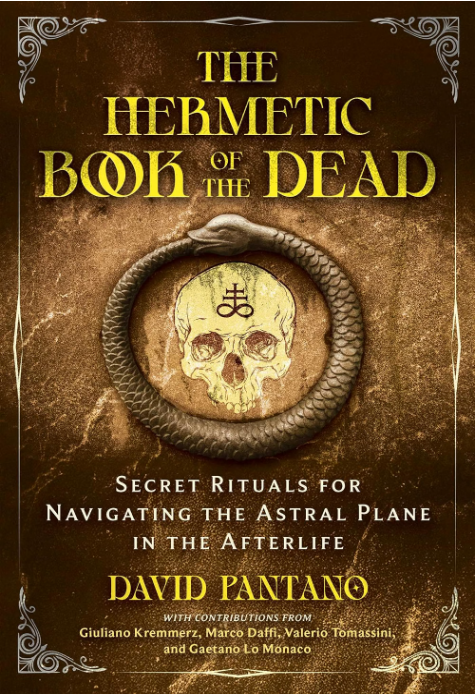
The Hermetic Book of the Dead: Secret Rituals for Navigating the Astral Plane in the Afterlife by David Pantano
Review: Gwendolyn Taunton
David Pantano is well known for his work on the esoteric traditions of Italy, including The Magic Door – A Study on the Italic Hermetic Tradition, Alchemical Hermeticism: The Secret Teachings of Marco Daffi on Initiation, The Hermetic Physician: The Magical Teachings of Giuliano Kremmerz and the Fraternity of Myriam, and The Magic of Giuliano Kremmerz: Initiation into the Mysteries of the Fraternity of Myriam. His studies of Italy’s unique magical heritage have earned him a strong reputation, so a new work on the subject is always welcome.
His latest book, The Hermetic Book of the Dead: Secret Rituals for Navigating the Astral Plane in the Afterlife, draws on a diverse range of sources while continuing his work of revitalising Italian esoteric traditions. Seasoned students of the arcane will recognise some of this material, while other elements will be new to them, offering fresh stimulus well beyond what is found on the shelves of the local bookstore.
A word of warning, however: readers should not expect yet another Necronomicon. This is a book of the dead, but not the sort commonly imagined: there is no Lovecraftian cocktail of tentacles and other horrors here. Instead, it belongs to a genuine tradition and, like authentic traditional texts on the afterlife, presents death not as an ending but as a transformative threshold. Using Italian Hermeticism to connect ethical living, inner knowledge, and spiritual rebirth, it provides an Italian counterpart to the Egyptian Book of the Dead and the Tibetan Book of the Dead, unveiling secret doctrines and rituals that prepare the reader to pass through this liminal doorway to the other side.
Accordingly, the book focuses less on supernatural beings haunting the world than on magical heroes who have mastered their spiritual pathway and are granted a view of death that surpasses that of those who reach a mundane end. Life must be fully lived and heroically conquered. The magical hero faces great adversity and surpasses every difficulty life can throw at them, embodying dignity, discipline, and morality. This is not simply a martial struggle, though physical warfare is brutal to endure; it is the struggle Arthur Rimbaud wrote about: “Spiritual combat is as brutal as the warfare of men: but the vision of justice is God’s delight alone.” Ordeal therefore becomes a threshold condition. Embracing the heroic aspect can lead to purification and expanded consciousness, but if the adversity cannot be overcome, it can also produce confusion, illness, paralysis, or failed transformation.
Beyond the heroic ordeal, Pantano takes life’s inherent difficulties and casts them in a more philosophical light. A meaningful death requires a consciously lived life. Through disciplined self-knowledge, ethical refinement, imagination, and symbolic practice, the individual seeks to turn mortality into renewal rather than mere dissolution. The book’s many traditions and rituals reinforce the same Hermetic claim: the path is not only something one follows, but something one must become.
In this context, the book explores the evolution and impact of Italian ritual practices on life, death, resurgence, and rebirth through figures such as Virgil, Ovid, Dante, Giordano Bruno, and Marsilio Ficino. In the modern era, Pantano highlights the work of Kremmerz’s Fraternity of Myriam, Marco Daffi, and the Corpo dei Pari. In practical terms, initiation is not just a ceremony; it must create a transformational effect. Hermetic practice is a way to achieve this, overcoming impositions and limitations to integrate a more balanced and conscious identity, one that grants access to the numen and to the adherent’s own spiritual core.
In this way, by unveiling the wisdom of Italy, Pantano provides a narrative for the continuity of an Italian Tradition, a unifying theme he endeavours to deliver throughout his body of written work.
Structurally, the book is divided into eight parts that progress from the book’s Hermetic worldview and soul theory to healing, alchemy, symbols, reincarnation, and accounts of altered consciousness.
- The Hermetic Parables: This section establishes the book’s conceptual and cultural foundation. It presents Italian Hermeticism as a path of inner transformation rooted in symbolic imagination, memory, astral exploration, and “magical heroism.” Essays connect Daffi’s ideas to Pythagorean number, Tarot, Ficino’s divine frenzy, Bruno’s heroic furors, Vico’s poetic wisdom, and the ideal of a magus who unites ethical discipline with spiritual insight.
- Journey of the Soul: Here the author develops the book’s central account of death, postmortem states, and rebirth. It examines Daffi’s theory of avatars, the four Hermetic bodies, astral memory, karmic purification, and the possibility of preserving consciousness across incarnations. Its centrepiece is the Hamzur/Andromeda ritual, which dramatises the soul’s passage through judgement, confrontation with karmic burdens, purification, and renewed ascent.
- Medicinae Dei: This part describes Hermetic healing as a union of ritual, symbolic correspondences, plant materials, and the practitioner’s purified consciousness. Illness is interpreted within the book’s esoteric framework as an imbalance across physical, psychic, and spiritual levels.
- Elixir of Life and Renewal: This section centres on the Flos Caeli, a seventeenth-century alchemical manuscript concerning the “Flower of Heaven”. The text treats it as an Elixir of Life, while the introduction interprets its operations—collection, dissolution, fermentation, distillation, and coagulation—as symbols of the Great Work: separating impurities and re-forming a purified, enduring essence.
- Symbols and Myths of Italian Hermeticism: This part depicts Roman and Mediterranean images as carriers of Hermetic meaning. Roman obelisks, the Magic Door, the ibis, and the phoenix are interpreted as symbols of cosmic energy, threshold-crossing, intelligence, death, and regeneration. The section closes with a Renaissance Life of Hermes Trismegistus, portraying Hermes as teacher, lawgiver, astrologer, and guide to a virtuous life.
- The Hermetic Principles: This section sets out the book’s model of consciousness and the human being. It maps four realms—Inferno, Terra, Purgatorio, and Paradiso—onto Saturnian, Lunar, Mercurial, and Solar dimensions of experience. It also explains the physical, astral, mental, and spiritual bodies; the caduceus as a model of polarity and transformation; and the astral as a reservoir of memory, imagination, ancestral influence, and symbolic perception.
- Perspectives on Reincarnation and Initiatic Death: This next section brings together comparative and critical reflections on rebirth, spiritual death, eros, purification, and immortality. It draws on Patañjali’s Yoga Sutras, Kremmerzian alchemy, Christian resurrection symbolism, parapsychological cases, and Hermetic theories of postmortem survival. The recurring claim is that death reveals rather than erases the moral, imaginative, and spiritual patterns formed in life.
- Explorations in Consciousness: This final part offers experiential accounts and reflections concerning visionary states, dreams, prayer, ayahuasca, pilgrimage, Orphic ritual, and the Tibetan Bardo. These writings use such experiences to explore memory, altered consciousness, fear, symbolic encounters, and preparation for death. The part concludes with Kremmerz’s magical prayer and a prayer for a dying person, emphasising attention, imagination, and compassionate accompaniment at life’s threshold.
Taken together, the book presents the aim of becoming a magical hero. Esoteric practice lays the groundwork for this process, and conscious living is the means by which death is turned into renewal.
This leads toward the concept of Initiatic Death. Here the reader finds discussions of karmic judgement, postmortem states, memory and amnesia, and the possibility of preserving awareness beyond bodily death. A core tenet is that one’s postmortem condition reflects the mental, ethical, and spiritual content cultivated in life. The book treats death as a passage of purification, rebirth, and possible spiritual awakening rather than an absolute end.
Within this discussion of Initiatic Death, the book offers an account of the Italian Hermetic katabasis: the initiate passes through Inferno, Purgatorio, and Paradiso, then returns to Terra “reborn, purified, and transformed.” These realms are explicitly aligned with the alchemical stages of nigredo, albedo, and rubedo, making the cycle both transcendental and transformative, as the author expertly conveys.
Taken as a whole, David Pantano crafts an eloquent synthesis of ancient and modern approaches to the transformative nature of katabasis and the esoteric process of initiatory death, making The Hermetic Book of the Dead essential reading for the living. His strength lies in tracing a continuous Italian magical lineage and treating it as a living practice rather than a historical curiosity.
That said, the book will reward readers who already have some grounding in Hermetic and mystical thought. Newcomers may find the specialist vocabulary and the density of names and sources demanding, but the central message remains clear: a meaningful death depends on a consciously lived life, and the path is something one must become, not merely follow. Its portrait of the magical hero, who meets ordeal with dignity, discipline and morality, gives that message an ethical weight that sets it apart from sensational treatments of the afterlife.
Ultimately, The Hermetic Book of the Dead offers a serious, thoughtful and rewarding counterpart to the Egyptian and Tibetan Books of the Dead. It treats death as a passage of purification, rebirth and possible spiritual awakening, and in doing so speaks as much to the living as to the dying. It is essential reading for anyone drawn to the Western esoteric tradition.